Every order. On video. Dispute-proof.
“Aku ada rakam, tapi bila buyer cakap kotak kosong, aku tak tahu klip yang mana.”
A packing video system is not a camera pointed at your table. It is a short routine that puts every parcel on video, ties each clip to the order it belongs to, and keeps the clip somewhere you can find it months later when a claim opens. Most sellers who try this stop within two weeks, and the camera is rarely the reason. Nothing connects the clip to the parcel.
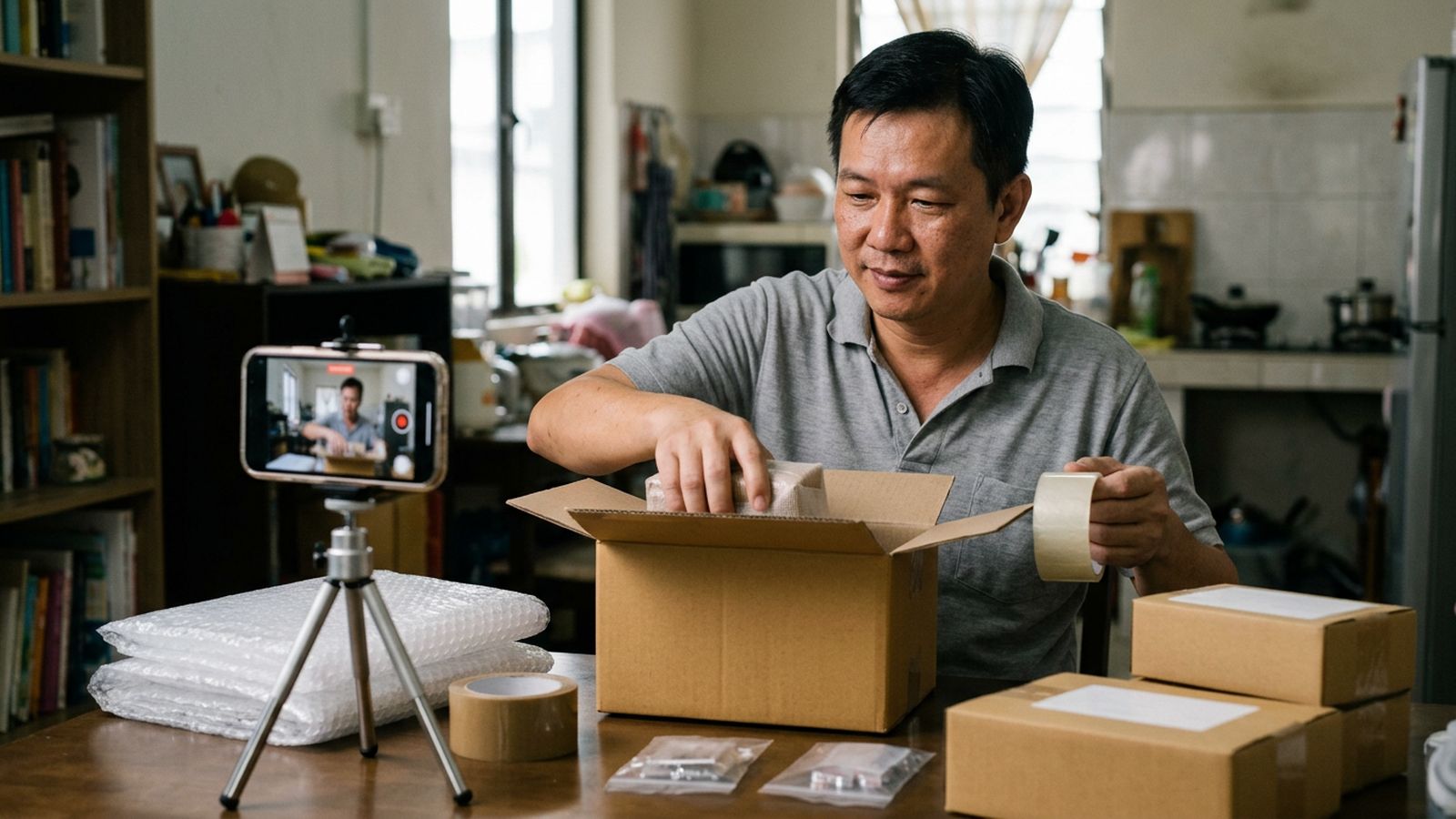
Here is the version that survives a busy day in a small shop, plus what a clip can and cannot prove.
What a packing video system has to do
Four jobs, and a tripod alone does none:
- Record every parcel. Not only the order that felt off. The claim that arrives is almost always on the one you skipped.
- Attach the clip to the order. The tracking number has to appear in the frame, or the clip belongs to nobody.
- Start and stop without your hands. Anything that slows the packing line gets abandoned within a week.
- Store it where you can search by order. A gallery sorted by date cannot answer a question that arrives six weeks later.
The setup, using what you already own
A phone, a stand and a fixed spot are enough to start. Shop CCTV runs continuously and rarely shows the label clearly.
- Phone you already own. Any recent phone filming 1080p is enough. Leave the spare phone at the station instead of pulling your main phone out fifty times a day.
- A stand. A small tripod or a clamp arm. It must not move between parcels, because a moved camera means a new angle to re-check.
- Light on the parcel, not on the lens. Bright window behind the camera, not behind your hands. A parcel lit from behind shows a dark rectangle.
- Power at the station. A charger and cable that stay there. A phone that dies at 3pm teaches you the routine does not work.
- A storage plan before you need it. Clips have to leave the phone, either to storage you control or to a tool that syncs for you.
Where to point the camera
Set the frame once, then leave it. It needs the label, the item going in, and your hands, at the same time.
- Shoot slightly above table height, angled down, so hands move across the box instead of covering it.
- Keep the bottom of the frame clear, so the parcel is the clearest object in the shot.
- Test once with an empty box: seal it, turn it over, show the label. If the number is unreadable to you, it is unreadable to whoever decides the claim.
- Put the label in frame twice, at the start and at the end. That habit ties one clip to one parcel when fifty parcels leave in a week.
Run it without slowing the day down
- Build it into one motion. Scan the airway bill or start the recording, then pick the item.
- Say nothing. Narration is not evidence, and it slows you down.
- Repeat the same four beats. Label, item into the box, seal, label again.
- Close the day with the clips. Check today’s recordings uploaded. A clip still in the gallery is not evidence yet.
What the clip proves, and what it does not
Be precise here.
A clip tied to the label proves what was inside the parcel when you closed it, and when that happened. It does not prove what happened after the parcel left your hands, or what the buyer found when they opened it. Two questions, two kinds of record.
- A timestamp burned into the frame beats file metadata. File properties can be questioned. A clock rendered into the video cannot be separated from it.
- Editing weakens a clip. Cut footage invites the question of what was removed. Keep one continuous take, raw.
- Never promise yourself a win. Outcomes depend on the channel and the case. What the record does is make your side checkable rather than arguable.
What is packing verification goes through the same distinction in more detail.
Five mistakes to skip
- Filming only the orders you are worried about.
- Clips with no label anywhere in the frame.
- Stopping before the box is sealed.
- Leaving clips in a gallery sorted by date.
- Posting clips publicly, where they carry a buyer’s name and address.
A setup checklist you can finish this week
- One station, one fixed angle, tested with an empty box.
- Label visible at the start and at the end of every clip.
- Every parcel gets a clip, including the cheap ones.
- Hands free start and stop.
- Clips off the phone before you close the shop.
- Search by order number, not by date.
- Buyer chat stays inside the platform.
Consistency is the whole system.
If you would rather not build the routine yourself, Packory handles the parts that keep failing: scanning the airway bill starts the recording, a timestamp is burned into every frame, a thumbs up stops the clip, and the video syncs to your own cloud storage, searchable by order. Free to start, and it works with Shopee, TikTok Shop, Lazada and Shopify.
If margin is the reason you are hesitating, run your numbers with the free fee calculator first, and if you want to screen a new buyer before the parcel leaves, Buyer Check is free to use.
Packory records packing video for every order, hands free and linked to the order, so a claim becomes a question of facts rather than a story. Free to start: start free